Engineering Workspace / Mail & Follow-ups
VMy day

Mail, Calendar & Follow-ups

Three honest ways in — Outlook on the computer the workspace runs on, your own Microsoft account, or Thunderbird through a small connector — and your correspondence starts working for you. The app reads and drafts; it never sends.

Follow-ups with a brain

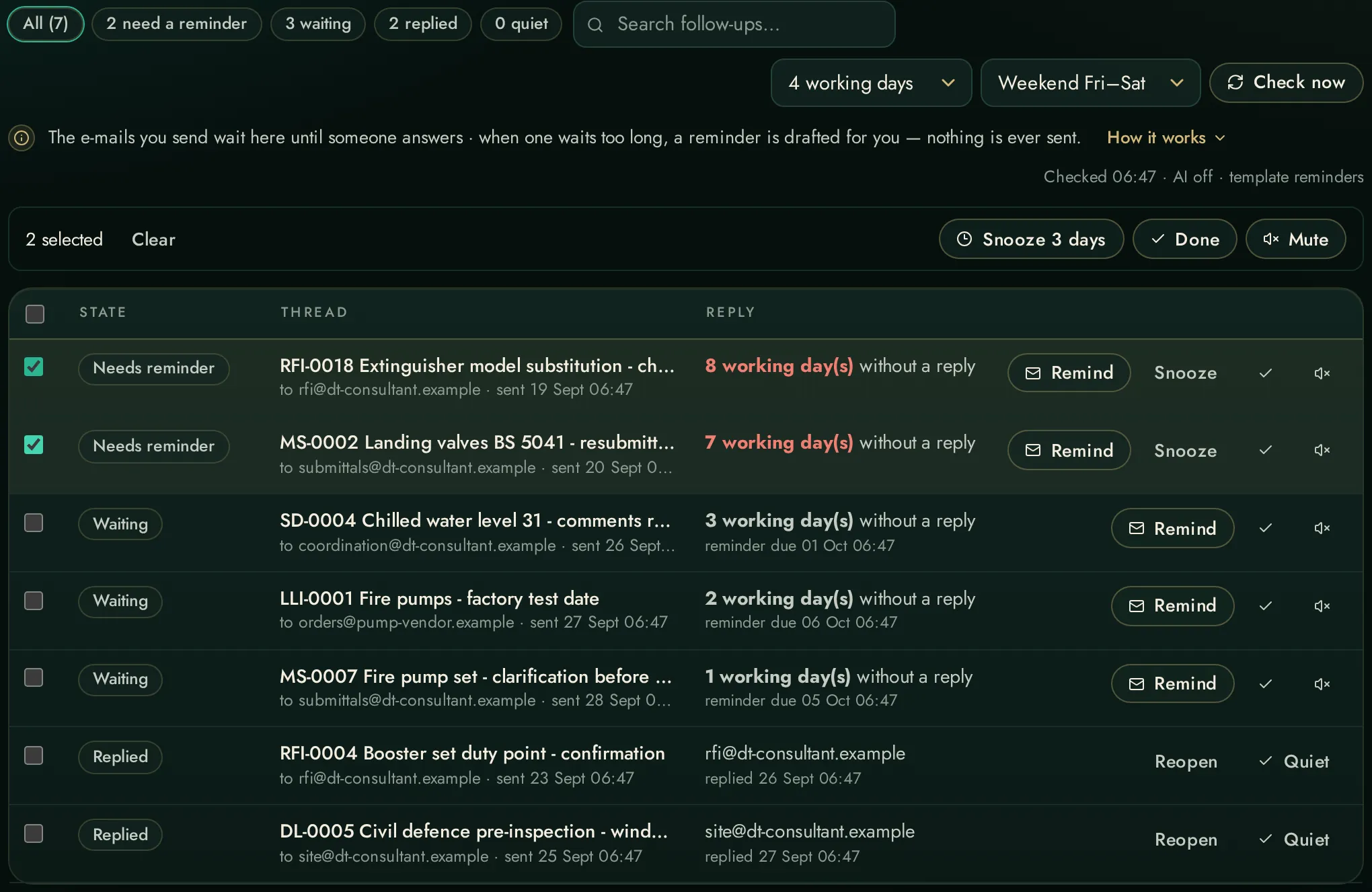
Real asks are tracked automatically; meeting invitations, auto-replies and no-reply robots are filtered out. When a thread waits past its patience — counted in working days on your weekend — the bell rings and a chaser is already drafted.

Replies detected from the inbox automatically
Patience in working days; weekends never count
Tick several and act at once; quiet threads stay quiet
Follow-ups with a brain

Meetings arrive pre-briefed

The calendar highlights today, and any meeting can produce a prep pack: related documents, open register items on the subject, and recent correspondence — assembled deterministically, cached for the week.

Prep pack: one press, reused all week
Open items ranked overdue-first
Minutes drafted from your rough notes

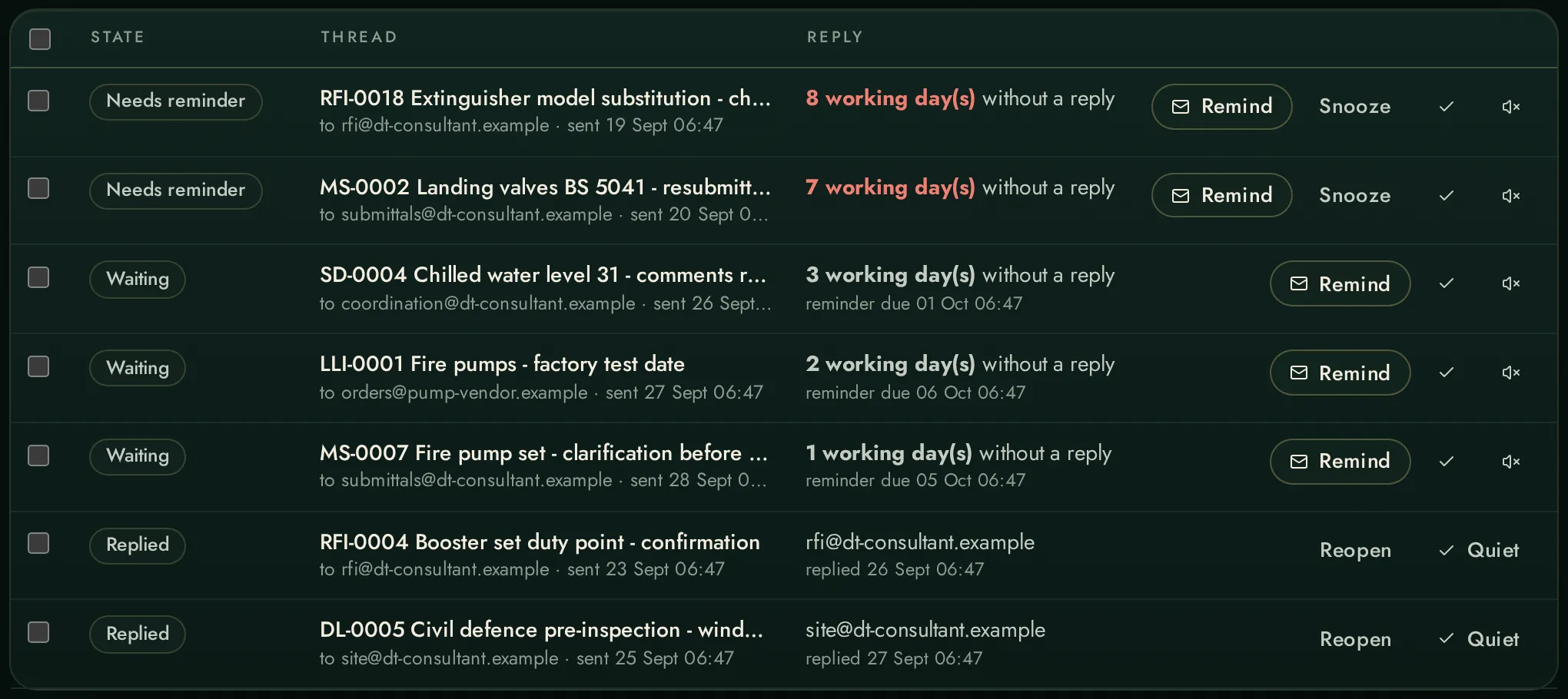
Three states, zero ambiguity

Needs reminder, waiting, replied — every thread tells you its state and its clock at a glance.

Three states, zero ambiguity
Cropped from the live follow-ups list.
Every capability, declared

The complete list.

Everything the mail brain does — and everything it deliberately never does.

Connection & privacy

Outlook on this computerOn a Mac, Outlook (Legacy); on a PC, classic Outlook — read directly, nothing to set up, no approval to ask for. The new Outlook cannot share its mailbox with any program; the page says so and shows the way round. A “Check Outlook” button names what stands between the app and Outlook, and on a PC a read Outlook never answers is ended instead of holding the page.
Your account, your sign-inPer-user Microsoft sign-in via the official device-code flow — at microsoft.com, never in the app.
When IT must approveCompany tenants sometimes answer “Need admin approval”. The sign-in window then shows the exact permissions (read-only) and a ready message for IT with the approval link — one approval, then everyone in the company signs in.
Thunderbird as the readerRead your mail in Thunderbird (free; Microsoft 365, Google, any IMAP account) and a small connector hands it to the workspace on this computer only. On a PC the app registers the connector for you; Thunderbird installs it at its next start.
Per-user encrypted tokensNo user — and no API — can read another's mailbox. Ever.
Reads and drafts onlyThe workspace never sends mail, never edits your mailbox, calendar or notes.

Follow-ups

Track what THEY promised youOne press on a received e-mail puts the sender's promise on the same board, chased with the same patience — a commitment made to you is a commitment either way.
Automatic trackingEvery real ask you send becomes a tracked thread — invites, auto-replies and no-reply robots filtered out.
Working-day patienceChoose the patience (e.g. 3 working days); weekends — YOUR weekend — never count.
Reply detectionReplies found in the inbox automatically close the wait and name who answered, and when; a resend after a reply reopens it.
Drafted chasersWhen patience runs out, a polite chaser is already written — you send it, or not.
Quiet threads + reopenSilence a thread without losing it; every item links back to the original conversation.
Who owes youEach thread names the person and the days — the chase list writes itself.
Rows you act on togetherTick several threads, or all of them, and remind, snooze, close or mute them in one press; a search finds any thread, the quiet ones included.
Within reach without a mailboxSigned out, or not connected yet: the threads the workspace keeps stay one tab away — reminders drafted, threads snoozed, closed or muted — and the board says replies are looked for once a mailbox is connected.

Calendar & meetings

Today, unmistakableThe calendar marks today so a week view never confuses you.
Meeting prep packsDocuments + open register items + recent mail on the subject — deterministic, cached 7 days, saved to your files.
Minutes from notesRough notes become formal minutes — attendees, decisions, actions with owners.
Notes → actionsOneNote on a Windows PC or Apple Notes on a Mac surface as structured briefs — iPad handwriting included — with each action producible in one press, from the Notes page.

Triage & reading

AI inbox triageUrgent-action / action / awaiting-others / info / noise — with a one-line reason each.
Letters keep their numberingA consultant's five-point letter arrives as five numbered points, not five items all called “1” — the reader takes the rich body and keeps Word's own list numbers.
The inbox briefA composed morning read of the mailbox: act on these, worth knowing, waiting on — each line linked to its thread.
Attachments in placeA message's attachments appear as chips and open right there — fetched on demand into a small self-pruning cache, never stored twice.
The whole thread, then a summaryRead a conversation from day one in one reader, and press once for a streamed summary of what has been agreed, refused and left open.
The message beside the listOn a wide screen an opened message sits beside the list, as in Outlook, and stays in sight while the list scrolls.
Conversations, opened in placeA conversation of several messages opens from a gold pill carrying its number; its messages sit on a tray of their own, newest first — who wrote each, when, and how it begins — and the triage's next step has a strip of its own.
A thousand conversationsThe list holds up to 1,000 conversations (500 from Outlook on a Mac): the newest arrive at once and the older mail is read in the background.
The whole mailbox, searchedA search goes to the mailbox itself: Outlook's own filter on a PC, subjects on a Mac, Microsoft's search or Thunderbird's. Nothing older than the list is out of reach.
Handwritten notes, read backHandwriting in OneNote (Windows) or Apple Notes (Mac) comes back as a numbered brief — each point extractable into an action the workspace produces.
Draft repliesA reply drafted with project facts searched from the knowledge base — never sent by the app.
Mail into the recordIngested correspondence lands in the knowledge base folder, searchable like everything else.
Arabic, the whole pageEvery tab and window of the Mail page reads in Arabic, while subjects, names and addresses stay as they were written.
Against the field — correspondence
Sent mail becomes tracked, chased, working-day-clocked promises
Mail lives in Outlook; the follow-up lives in memory
Meeting prep assembled from mail + registers + documents
You assemble it yourself, meeting by meeting
Drafts only — the app never sends
Automation products that send on your behalf and get you in trouble

"The field" is the usual toolchain — the per-user construction cloud and the separate applications around it. Good tools; the difference here is one integrated record, on your own server.

Install it and begin — free for 14 days.

Nothing to request and nobody to wait for: download it, install it, and the 14-day evaluation starts by itself the first time it opens.
Download and install →
← Search & AskStudios →