Engineering Workspace / Search & Ask
IThe record

Search & Ask

The archive stops being a place where answers go to hide. Ask in plain language; get the clause, the reply, the drawing note and the calculation — each with its page.

2:05 · WATCHThe knowledge base that actually reads your project
The knowledge-base film: indexing, asking, and the page-cited answer.

One question, four sources, three seconds

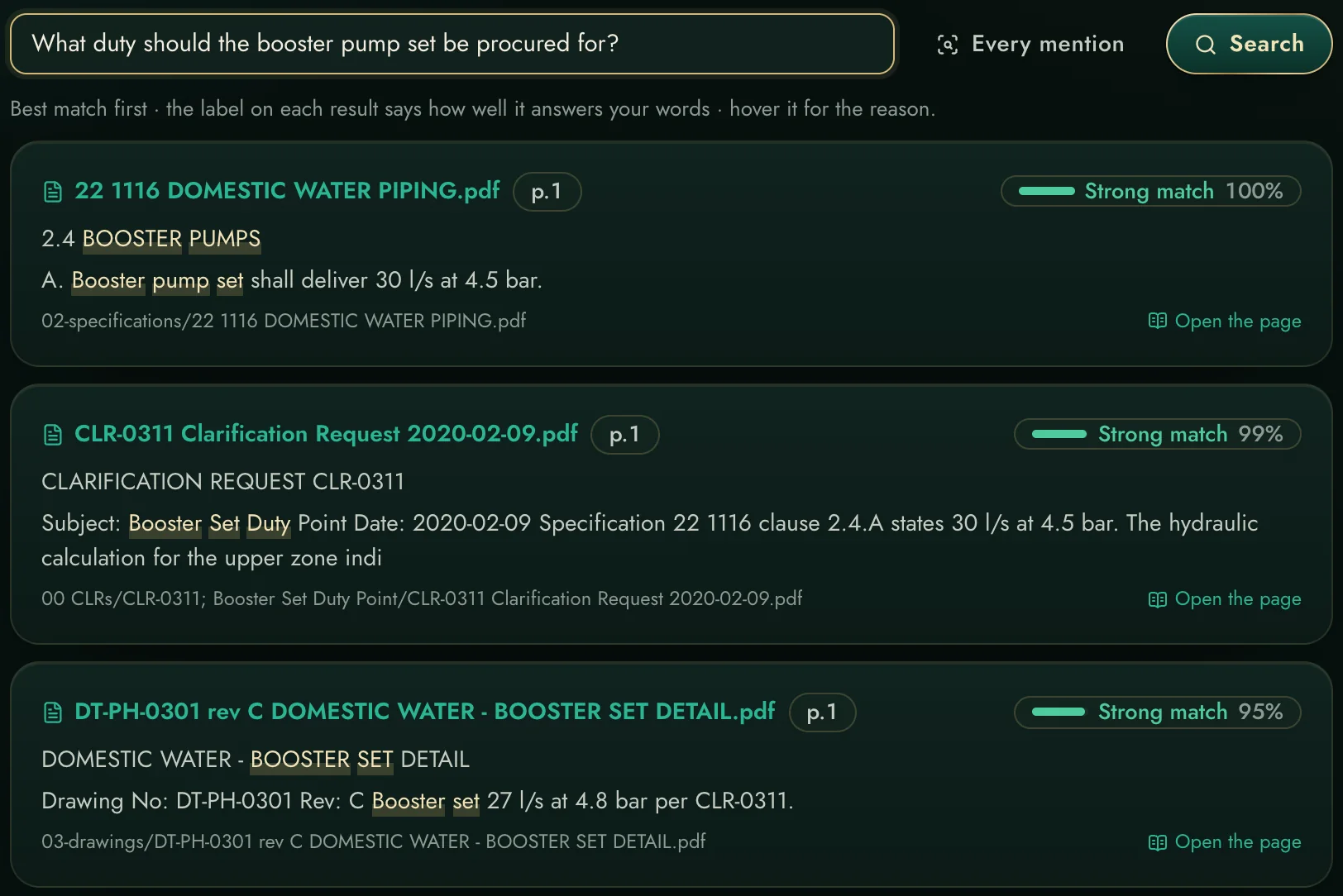
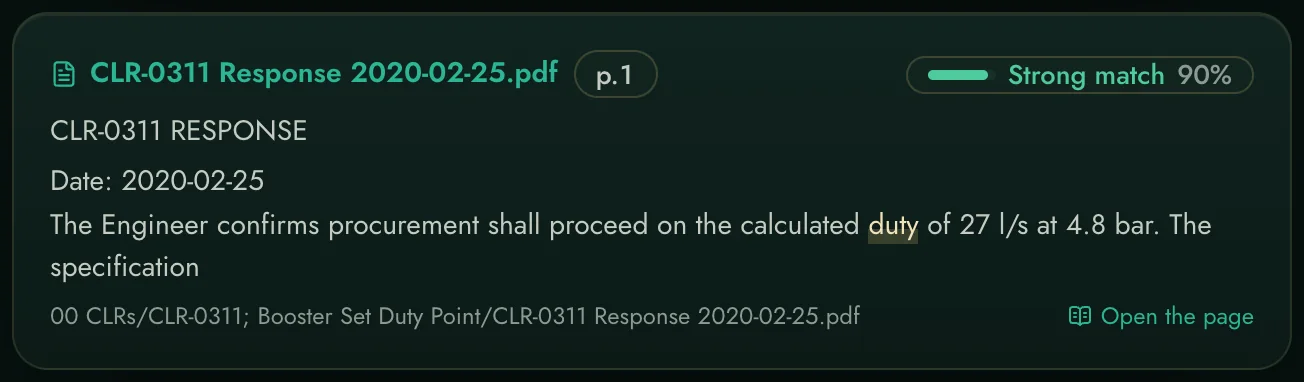
“What duty should the booster pump set be procured for?” returns the specification clause, the clarification that questioned it, the drawing that carries the answer and the Engineer's response — ranked, scored, page-cited.
Meaning + keyword search with reranking
Every hit shows document, page and heading
‘Every mention’ sweep for exhaustive coverage
One question, four sources, three seconds
Answers you can defend
A single hit, cropped: its match, page, heading and passage.

Answers you can defend

A result is only useful in engineering if you can cite it. Every passage carries its document and page — paste it into a reply to the consultant and stand behind it.

The Library behind it

Folders you recognise, indexed status on every document, and files opening from the project, your OneDrive, your mail attachments or this computer.
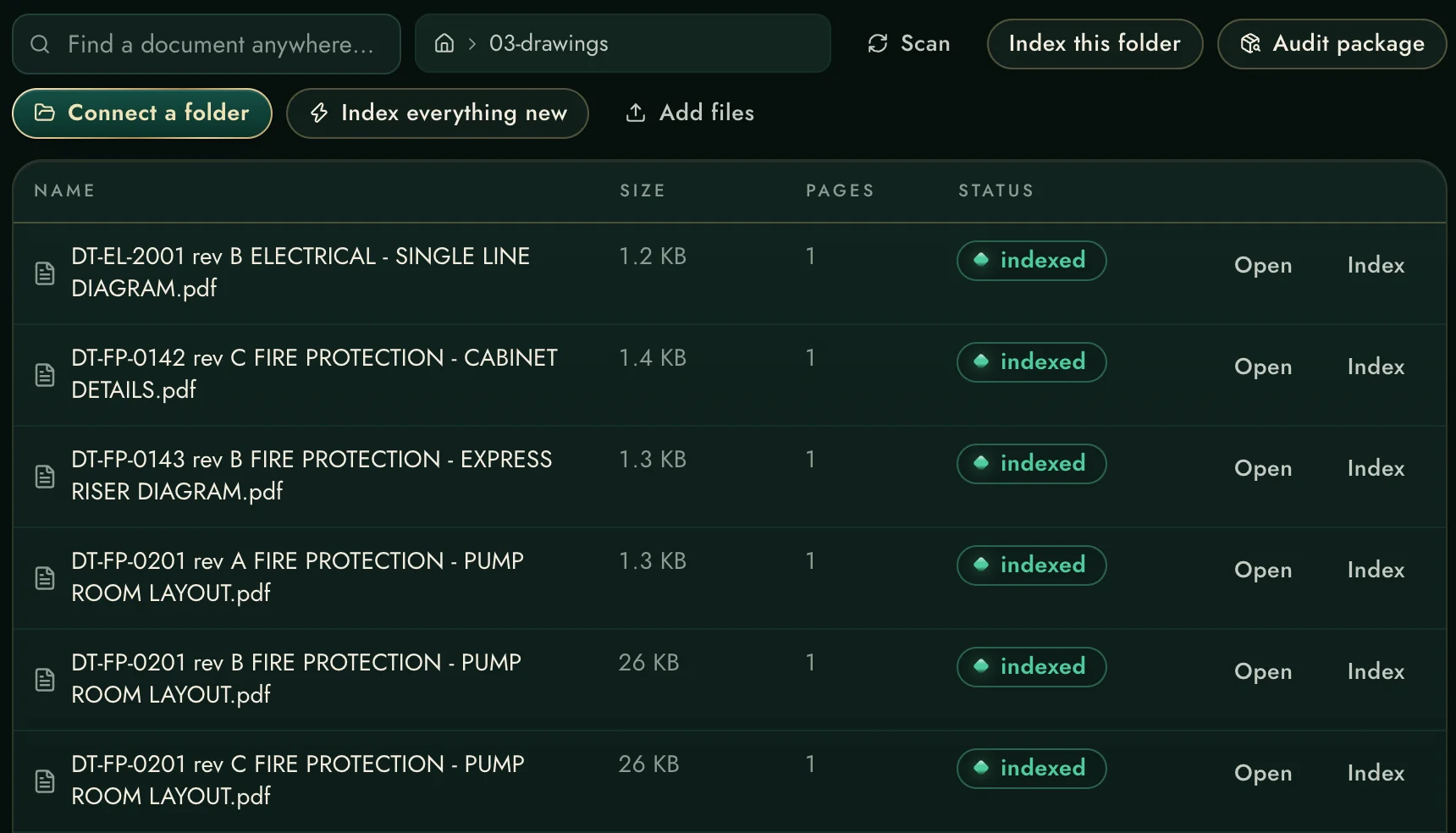
Watched folders index new arrivals automatically
OCR for scans — English and Arabic
Same file picker in Library and both Studios
The Library behind it
Every capability, declared

The complete list.

The intelligence engine, spelled out.

Reading

Every format that mattersPDF, Word, Excel, scanned images, drawings — read into one knowledge base.
OCR, English + ArabicOld letters and stamped drawings become searchable text — the archive stops being a blind spot.
Watched foldersNew arrivals index themselves; the knowledge base is as fresh as the last document.
Coverage you can act onEvery document that needs attention is listed with its reason, searched, ticked and accepted together; Editions says in words whether a cited code is in the library.
Per-project isolationEach project keeps its own index — switching projects switches the brain.
Drawings, out of the boxDWG and DXF drawings are read with a bundled converter — no extra install, on Mac or PC.

Finding

Hybrid searchMeaning-based + keyword, together, reranked — finds 'pump clearance' when the letter says 'access around the skid'.
Every-mention sweepExhaustive mode: every document that mentions a term, with true counts.
Ask with citationsPlain-language answers composed from the evidence, each claim cited (document, p.X).
Citations libraryReal answers auto-capture their citations for reuse in letters and reports.
⌘K everywhereThe palette searches and jumps from any page.
Two quality tiers, your choiceFast for everyday recall; Deep for large technical libraries, on a computer with more than 32 GB of memory. The app reads the machine's memory and picks one for the first index — switch later and the index rebuilds from what was already read, never from the documents again.
Orders survive the pageAsk, leave, come back: the answer is waiting. Nothing you start is lost to a page change.

Economics

Runs on your serverIndexing and search cost nothing per use — a thousand questions a day, zero bill.
Works offlineThe engine needs no internet; the archive answers on a site cabin generator.
No data leavesDocuments, index and questions stay on your hardware.
Against the field — search
Ask the archive, get a page-cited answer, locally
Filename search; AI answers only via their cloud, at extra cost
Arabic scans readable and searchable
Latin OCR at best; the Arabic archive stays dark
Zero marginal cost per question
Per-user AI add-ons priced monthly

"The field" is the usual toolchain — the per-user construction cloud and the separate applications around it. Good tools; the difference here is one integrated record, on your own server.

Install it and begin — free for 14 days.

Nothing to request and nobody to wait for: download it, install it, and the 14-day evaluation starts by itself the first time it opens.
Download and install →
← Before the pourMail & Follow-ups →